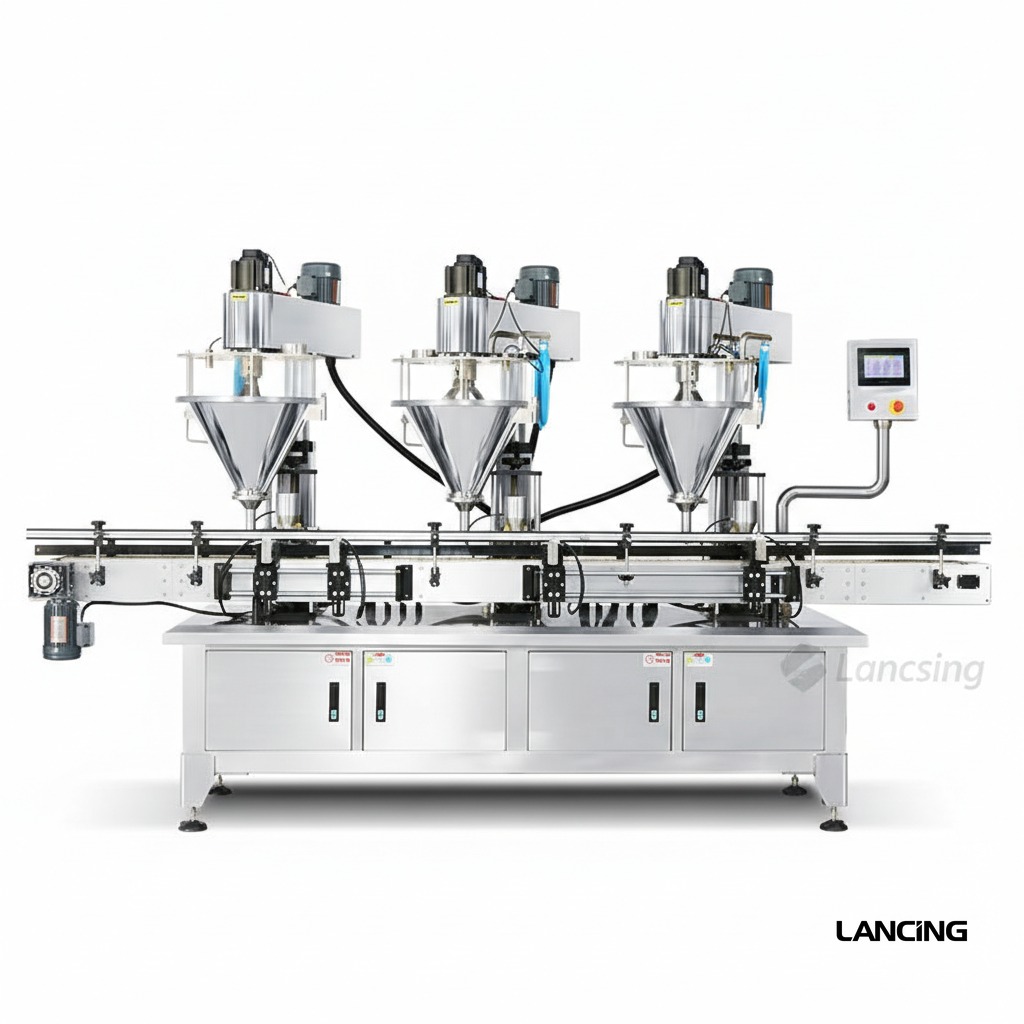
Separate dosing-cycle speed from sustained finished-pack output.
An automatic filler can only run as fast as product feed, pack presentation, dosing, settling and downstream closing allow. Define the output target as acceptable finished packs over an agreed run using the real product and pack. Include normal hopper refills, closure replenishment, checks and short recoveries. A multi-head machine may increase dosing capacity, but only if product is distributed consistently and every head is balanced against the same acceptance criteria.
Design container handling around the least stable format.
Provide samples of the smallest, tallest, lightest and widest container. Check base stability, neck or opening diameter, conveyor side-guide contact, pitch, fill height and the effect of product impact. No-pack/no-fill logic should prevent discharge into a gap, while recovery from a skewed or missing pack should not create an uncontrolled queue. Where powder needs time to settle, provide enough distance or dwell before capping, sealing or labelling.
| Interface | Define in the specification | Prove during trial or acceptance |
|---|
| Product feed | Hopper level range, refill request, transfer method, overfill protection and dust connection. | Stable fills through a normal refill without bridging, flooding or density shift. |
| Container infeed | Pitch, gating, orientation, minimum gap, no-pack/no-fill and jam recovery. | Repeatable positioning for every intended pack format. |
| Filling heads | Tooling identity, recipe, head balance, fill-complete and fault response. | Separate and combined statistics for the agreed sequence where multiple heads are used. |
| Downstream | Settling, cap or seal permissive, label/code trigger, reject and accumulation. | Acceptable finished packs at the sustained target rate. |
Write the control philosophy before connecting machines.
Identify the line master and the ready, run, stop and fault signals exchanged with product feed, capping, sealing, labelling, coding and checking equipment. Define what happens after an emergency stop, a blocked discharge, a low hopper or a missing closure. Recipe names should identify the product, target, pack and tooling so that a saved setting cannot be applied to the wrong change parts.
Measure changeover from the last acceptable pack to the first acceptable pack.
List the parts, tools, cleaning steps, recipe changes and checks required for each SKU family. Include hopper emptying, screw or nozzle changes, conveyor guides, sensors, closure equipment and the first-fill verification. For cross-contamination-sensitive products, map residue points through feeders and extraction as well as the filler itself.